

The Great Inversion
How Britain Entered a New Era and Nobody Noticed

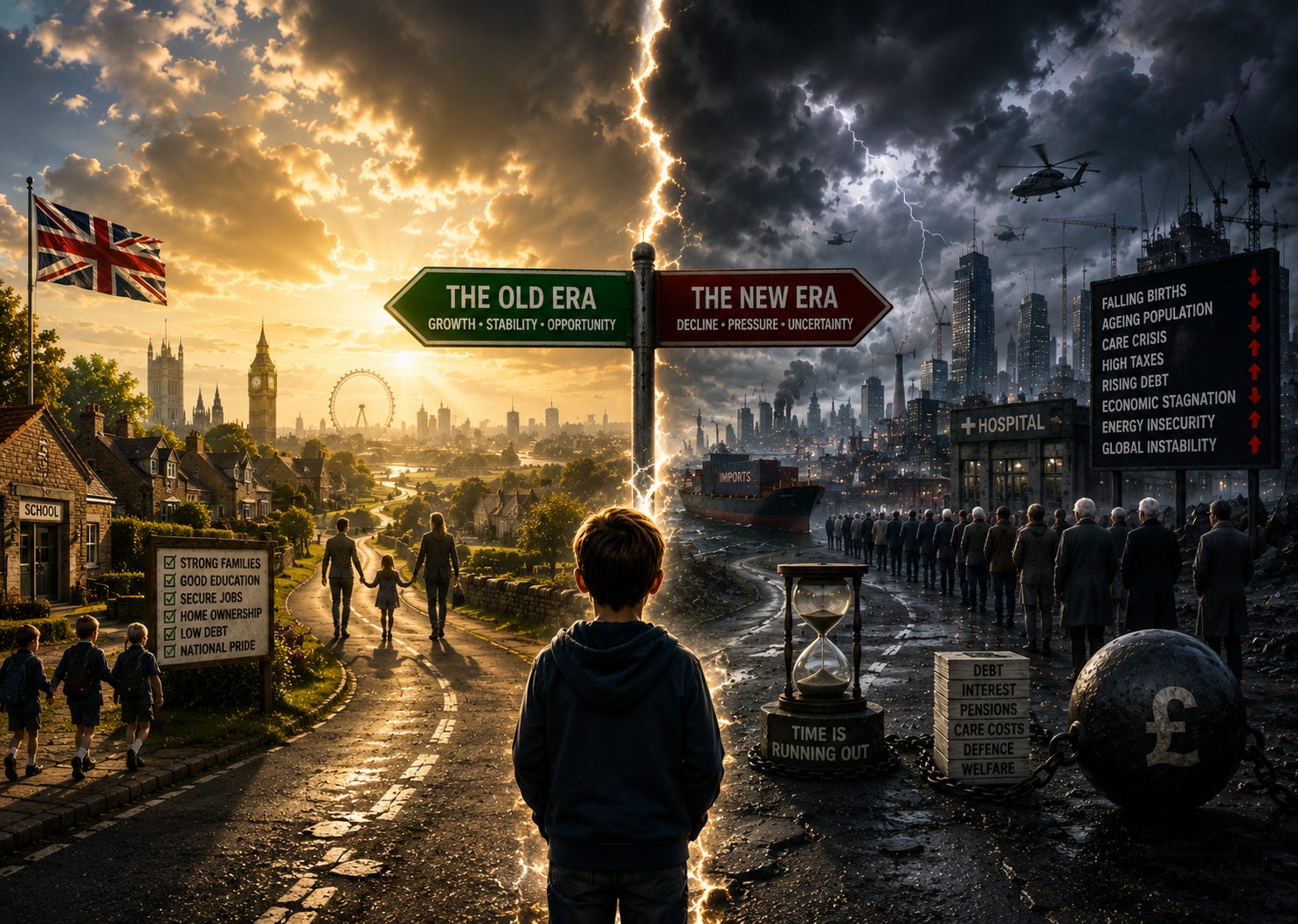
I’ve been writing a lot about Britain and the many problems it faces. In reality, it’s all been pointing towards this piece. The truth is, Britain has entered a new era. A new paradigm, in which the assumptions of the old world are inverting. I’m often asked what solutions I’d propose for the problems I uncover. The trouble is, that means treating symptoms in isolation rather than understanding the condition. So in this article I attempt to lay out my thesis for what’s actually happening. A new lens for looking at Britain. One that doesn’t hide the realities the old lens kept from view.
I. The threshold
Sometime around the middle of this year, on the Office for National Statistics’ central projection, Britain crosses a line it has never crossed before in the modern statistical record outside of war and pandemic.
Deaths begin to permanently exceed births.
This isn’t a blip. It’s not due to a bad winter. It’s the new normal. The ONS projects around 450,000 more deaths than births between mid-2024 and mid-2034. 6.4 million births against 6.9 million deaths. And on the actual registrations, the line has already been touched. Natural change first went negative in 2023. The fertility rate in England and Wales fell to 1.41 in 2024, the lowest since records began in 1938, and the third record low in a row. Just under 595,000 babies were born in England and Wales last year. That is the smallest number in the history of the series.
There’s been no announcement from Number 10. The Prime Minister hasn’t addressed the nation. And COBRA hasn’t convened. A country that has grown, almost without interruption, since the parish registers began, has quietly stopped replacing itself. And almost nobody has noticed.
I find that lack of notice more interesting than the fact itself. Because the demographic crossover is not a single event. It is the most visible of six thresholds Britain is crossing at the same time. Each one inverts an assumption that the modern British state was built on. Each one, on its own, would be the defining policy challenge of a generation. We are crossing all six at once, whilst conducting our politics as if none of them were happening.
This article is an attempt to lay out the new era plainly. What has inverted, what the numbers say, what the next ten and twenty years look like on current trend, why our framework of governance is not built for any of it, and what a country that took the inversion seriously might actually do.
I’ll say at the outset what this article is not. It is not declinism. Britain has been declaring its own decline since the 1890s and has been wrong, or at least early, every time. The sceptics deserve a proper hearing and they will get one below. My argument is narrower and, I think, harder to dismiss. It is that the assumptions have changed, the numbers describing the change are published by our own statistical agencies, and the political conversation has not caught up. You can dispute the timetable. The destination, or at least the direction of travel, is mostly arithmetic.
II. The six inversions
Every state is a bet on a set of assumptions. The post-war British state was a bet on six, even if not stated explicitly. A growing working-age population. A globalised trading order with secure supply chains. Abundant cheap energy and materials. A peace dividend. Human cognitive labour as the scarce, valuable input. And low-to-moderate taxation with fiscal headroom, financed where needed by patient domestic lenders.
Here is the state of those six bets in 2026.
The first inversion: the people.
The growth assumption is dead. On the ONS’s 2024-based projections, every year of natural change from mid-2026 onwards is negative. The population still grows for a while, to 71 million by 2034, but every single person of that growth is migration. Under the zero-net-migration variant, the population was projected to start falling from mid-2025. Scotland declines from this year. Northern Ireland from 2032. Wales from 2036.
And the structure inverts faster than the total. By 2034 there will be 14.2 million people of pensionable age, one in five of us, whilst the number of children falls by 1.6 million. I have written before about what that looks like on the ground. It looks like primary schools consulting on closure from Westminster to Nottingham, because the children who would have filled them were never born. The reception class of 2026 is the payslip of 2045 and the pension contribution of 2060. The absence moves through the system like a shadow, and it has already entered the building.
If you want to see the far end of this road, look at Japan. Deaths first exceeded births there in 2007. Nineteen consecutive years of natural decline later, the annual gap is approaching a million people, the fertility rate has fallen to 1.15, and the 2023 housing survey counted nine million empty homes. One dwelling in seven, vacant. Whole regions are being administratively abandoned. Japan is not a warning about the future. It is a report from twenty years up the road we have just turned onto. And as I’ll get into, Japan is the best case scenario. For Britain, we have a very different set of circumstances that mean we’ll likely experience this transition very differently.
The second inversion: the work.
For two centuries, every great labour transition released workers to do something more productive. Agriculture went from most of the workforce to 1% because machines could farm. Manufacturing shrank because machines could make. The assumption underneath the modern economy is that labour flows, over time, toward higher productivity.
That assumption has inverted. The fastest-growing claim on British labour is now care, the sector where productivity gains are hardest to find, because care is time. A carer with twice the patients is not twice as productive. They are delivering half the care. And this is why Baumol’s Cost Disease is likely to be a key feature in economic commentary for years to come.
The numbers are remarkable even before you project them. The Institute for Fiscal Studies calculates that if the NHS workforce plan is delivered in full, one in eleven of all workers in England will be employed by the NHS by 2036. One in seventeen as recently as 2021. Nearly half the entire public sector workforce, in a single employer. That is before adult social care, where Skills for Care says 470,000 additional posts are needed by 2040, on top of the 111,000 vacancies the sector carries on any given day.
And note what that projection is pegged to: the over-65s. The assumption that care is simply an ageing story is the first thing the actual spending data corrects. Councils in England now spend almost as much on long-term care for working-age adults, £10.4 billion, as they do on older people, £11 billion. 300,000 working-age adults receive publicly funded long-term care, and theirs is the most expensive care in the system, at £1,823 a week against £1,019 for the elderly. The prevalence of disability among working-age adults is rising for reasons that have nothing to do with the baby boom. Which means the official projections, alarming as they are, are pegged to only half the problem.
Then add childcare. Then add the 5 million unpaid family carers whose work was valued, on the census basis, at £162 billion a year in England and Wales. The researchers who produced that figure described it as a second NHS. They were not exaggerating. It is roughly what the actual NHS cost in the year they measured.
Put the pieces together transparently, England figures handled carefully, and the health and care share of all employment plausibly reaches somewhere between one in seven and one in six workers by the late 2030s. If the total workforce stops growing, which is what the demography implies, the share rises faster still, because the denominator stops moving.
I have called this the Great Conversion, because you can watch it happening monthly in the payroll data. The largest fall, almost every release, is retail. The largest rise, almost every release, is health and social work. The market economy shrinks, the care economy hires, and each swap hits the Treasury twice. A job that paid tax disappears, and a job that tax pays for replaces it.
And the conversion is only the visible subtraction. Care removes workers from the productive economy through more channels than employment statistics show. 1.5 million working-age people are economically inactive because they are caring for someone, unpaid. A record 2.8 million more are inactive through long-term sickness, up 800,000 since the pandemic, and the government’s own review expects a further 600,000 to follow by 2030. The benefits supporting them are forecast to grow from £65 billion a year to £101 billion by the end of the decade. These groups overlap, so resist the temptation to add them. What they share is the point: every one of them is a working-age person whom the official dependency ratio counts as a worker. Britain is the only G7 economy whose employment rate never recovered from the pandemic. Nine million working-age people are not in the workforce at all, whilst the published ratio of workers to dependents assumes they are. The real arithmetic of the inversion is worse than the official version. The official version is already the worst in our history.
None of this is mismanagement. It is what an ageing, sickening society does to a labour market, arriving exactly on schedule. But it means the productive economy that funds everything else is being quietly cannibalised, from four directions at once, by the dependency it exists to support. And no party has a plan for it beyond hiring more carers, which is to say, accelerating it.
The third inversion: the world.
The post-war British model assumed an open, rules-based, broadly unipolar trading order in which an island could specialise in services and import everything else. That world is dissolving into blocs, and Britain’s exposure to the dissolution is close to a worst case.
Consider what we actually are. In the last quarter of 2025, Britain ran a goods deficit of £58 billion and a services surplus of £54 billion. We are a country that sells advice and buys things. The current account deficit ran at 2.4% of GDP last year, the second largest in the G7, financed, in Mark Carney’s famous phrase, by the kindness of strangers. We produce 65% of our own food, down from over 80% in the 1980s. 15% of our fresh fruit. We import the rest from a world that is re-learning the habit of using trade as a weapon.
And the materials that the next economy runs on are more concentrated than oil ever was. The International Energy Agency reports that China is the leading refiner for 19 of the 20 strategic minerals, with around 70% of global processing capacity, and the concentration is increasing, not decreasing. In the last 18 months China has restricted exports of gallium, germanium, antimony, tungsten and a list of heavy rare earths. These are not obscure commodities. They are the inputs to the energy transition, the defence industry and the digital economy, all at once.
A services-exporting, goods-and-food-importing island, in a world re-prioritising goods, energy and food security, having distanced itself from its nearest bloc. That is the position. It is not discussed in those terms anywhere in our politics.
The fourth inversion: the energy.
Britain industrialised first because Britain had cheap energy first. The whole arc of our prosperity sits on that fact. The assumption of abundance ran so deep that we stopped thinking of it as an assumption at all.
It has inverted. UK primary energy production peaked around 1999 and has declined ever since. Electricity consumption has fallen to levels last seen in the mid-1980s, not per person, in total, whilst generation is down roughly a quarter since 2005. For years we booked this as efficiency. Some of it was. But efficiency does not close chemical plants, and the price tells the truth. In 2024, before the current war began, British industry paid the highest electricity prices in the developed world. Roughly four times the American level. Some 46% above the median of the IEA countries.
Then the war arrived, at the end of February, and found us configured for maximum damage. Gas heats a greater share of British homes than in any other major economy. Gas sets the marginal price of our electricity more often than in any other market in Europe. The IMF’s April forecast cut UK growth for 2026 from 1.3% to 0.8%, the largest downgrade in the G7, citing precisely this exposure. A strong pre-war first quarter has since nudged the Fund’s number back up to 1%, which only sharpens the point: the momentum was ours, the drag is the war, and of the seven major economies, we take the biggest hit from the same conflict. The April GDP figures duly showed the economy shrinking. The shock did not find us unlucky. It found us undefended, at the end of twenty years of running down the one input everything else depends on.
And here is the part I find genuinely alarming. Every serious vision of the next twenty years is electric. Artificial intelligence and its data centres. Electric vehicles. Heat pumps. All of it requires the steepest expansion of electricity supply in our history, and we propose to attempt it with a grid we shrank for two decades and power priced like a luxury good.
The fifth inversion: the peace.
The peace dividend is being called in. The regular armed forces stand at about 147,000, which is 6% below target, less than half their 1985 strength, having shrunk in all but six years since the turn of the century. The National Audit Office found a £16.9 billion hole in the equipment plan, the largest in the plan’s history, within a £42.5 billion shortfall across the wider defence budget. On munitions, the politest credible assessment, given to the Defence Committee by the former head of Joint Forces Command, is that Britain could sustain a high-intensity war for about a week.
Against that, the commitments. 2.6% of GDP by next April. Under the NATO Hague agreement, 3.5% on core defence by 2035, with another 1.5% on wider security. The OBR prices the step to just 3% at an extra £17 billion a year by the end of the decade. That money does not exist. It will compete, line by line, with the care economy of the second inversion and the debt interest of the sixth, in a budget that is already the arithmetic expression of promises that cannot all be kept.
We have, meanwhile, entered the era of proxy conflict on multiple fronts, with the strategic posture of a much richer country and the stockpiles of a much more peaceful one.
The sixth inversion: the money.
This is the inversion I have documented most thoroughly elsewhere, so I will state it briefly and plainly.
The tax burden, at around 40% of national income, is at levels last sustained when Attlee was prime minister. Public debt is roughly 94% of GDP. Debt interest, depending on how you count the Bank of England’s holdings, runs between £110 and £126 billion a year, which makes the servicing of past decisions the fourth largest spending programme in the country, ahead of defence, ahead of policing, ahead of almost everything except the pensions, health and education that drive the borrowing in the first place.
And the lender has changed. For 70 years the gilt market had a captive domestic buyer in the British pension system. That buyer is leaving. Defined benefit schemes are running off their holdings to pay pensioners; the OBR projects their gilt holdings falling from 27% of GDP to under 6% over the projection horizon, and estimates the loss of that captive demand alone could add the better part of a percentage point to gilt yields. Who replaced them? Hedge funds now account for 63% of electronic gilt trading. Overseas investors hold a third of the stock. The Debt Management Office has cut long-dated issuance to 9% of the programme and the average maturity of new borrowing has more than halved in a decade, because the state now borrows where the remaining buyers are, which is short. A quarter of the debt is index-linked, so the one trick that rescued the 1970s, inflating it away, is contractually unavailable.
On current policy, the OBR’s own long-term projections show ageing pushing debt above 270% of GDP by the early 2070s. Nobody believes that path will be allowed to happen. Which is another way of saying that everybody quietly believes something large will interrupt it. The question this article asks is whether the interruption is chosen or suffered.
One more feature of the money deserves its own paragraph, because it connects to everything above. The income tax base is now extraordinarily concentrated. The top 1% of taxpayers, a few hundred thousand people, pay more than 28% of income tax. The top 10% pay over 60%. Three fifths of the top 1% live in London and the South East and work, overwhelmingly, in exactly the knowledge and professional services that the next inversion threatens. We have built a state of historic size on a tax base the width of a stadium crowd.
III. The seventh thing, which is not yet an inversion
I have left the technology out of the six, deliberately, because its numbers are different in kind. Everything above is measured by statistical agencies. The technology is a trajectory, and trajectories deserve more humility.
But the trajectory is real. The most careful public measurement we have, from METR, finds that the length of task frontier AI systems can complete reliably has been doubling roughly every seven months for six years. Extrapolation is dangerous and the expert disagreement is wide, and I want to be honest that this is benchmark evidence from a narrow domain, not a forecast of mass displacement. What can be said with confidence is the direction, and one structural fact about Britain’s exposure.
Every previous wave of automation hit manual labour. This one is aimed at cognitive work. At the graduate service class. At precisely the specialisation Britain spent forty years building, and precisely the narrow, high-earning tax base described above.
And here is the cruelty of the timing, which the Japanese evidence makes concrete. The labour Britain desperately needs, care, is the labour machines do worst. Japan, the most automated society on earth and twenty years ahead of us demographically, bet heavily on care robots. The careful studies, both the ethnographic and the quantitative, agree on the central finding even where they disagree on details: the robots did not reduce the labour required. In some settings they added to it. Machines cannot lift grandma, and grandma does not want them to.
So the technology arrives where Britain is strong and not where Britain is desperate. It threatens the tax base whilst leaving the care burden untouched. That is not an inversion yet. It is a sword hanging over the other six.
IV. Why nobody noticed
How does a country cross six thresholds at once without a national conversation about any of them?
Partly because each inversion is slow on a human timescale and invisible at the only timescale our politics measures, which is the news cycle and the parliamentary term. A fertility rate of 1.41 destroys no jobs this quarter. It closes a primary school in four years, shrinks the graduate intake in twenty, and bankrupts the pension settlement in forty. There is no single morning on which the inversion is the story.
Partly because the headline numbers are designed for the old world. GDP counts the conversion of shopkeepers into carers as activity like any other. The employment rate counts a tax-funded job and a tax-paying job identically. The deficit is reported annually whilst the commitments compound over decades. Our instruments report the weather of the old era. They have no gauge for the climate of the new one.
Partly because every inversion has a constituency for not noticing. Rising house prices were a wealth illusion that half the electorate enjoyed. Cheap imported labour deferred the care reckoning whilst flattering the growth figures. Short-dated debt is cheaper this year. The fiscal projections that matter all mature safely beyond the career horizon of everyone currently in office.
And partly, I think, because the truth is genuinely hard to hold. Six simultaneous inversions do not fit a manifesto. They barely fit an essay. The political market rewards the candidate who picks one symptom and promises to cure it, not the one who describes the syndrome.
But the syndrome is the story. Every one of these inversions compounds the others. The demography drives the care burden, which drives the spending, which drives the tax concentration, which deepens the exposure to the technology, which threatens the revenue that services the debt, which is now held by lenders who can leave overnight, in a world where the energy and materials and security we import are all repricing at once. It is one system. It is inverting together. And we are governing it with a machine built for its predecessor.
V. The machine
Which brings us to the machine itself.
The British state can still do some things quickly. It can stand up a furlough scheme in a fortnight. What it can no longer do is build, plan, or reform at anything like the speed the new era demands. The evidence is not contested, it is simply tolerated.
No major reservoir has been completed in England since the early 1990s, in a country whose population has grown by ten million since. Grid connections are quoted in years and sometimes in decades, in a country proposing the largest electrification in its history. Our last nuclear plant has been under construction longer than the entire Victorian railway boom took to connect every major city in Britain. The planning application for a single road crossing of the Thames has cost more than Norway spends building actual tunnels. These are not anecdotes. They are the operating speed of the system.
The deeper problem is that the system’s design assumptions match the old era exactly. Annual budgets for compounding decadal pressures. Departmental silos for problems that cross every department. A Treasury that prices everything at this year’s cost and nothing at this generation’s. Political incentives with a four-year horizon facing inversions with a forty-year one. The machine is not broken. It is doing what it was built to do, superbly, for a world that has ended.
History offers a clear, uncomfortable lesson about how machines like this get rebuilt. They get rebuilt in crisis. The 1832 Reform Act passed under fear of revolution. The Edwardian welfare state was born from the national panic when half the Boer War recruits were too malnourished to fight. Beveridge required total war. The 1976 IMF crisis forced in a fortnight what a decade of argument had not. The pattern repeats abroad: Sweden and Finland built the most disciplined fiscal frameworks in Europe in the rubble of their early-1990s banking collapses.
Foresight is rarer, but it exists, and its examples are the most important data points in this article. Singapore planned its water independence and its housing system across half a century. Ireland in 1987, broke and bleeding emigrants, struck a social partnership that held across governments and turned the country around inside a generation. Estonia built a digital state from a standing start because it had no legacy machine to defend. The common ingredients are worth stating: an honestly named emergency, a coalition wider than one party, and mechanisms deliberately placed beyond the reach of the annual political auction.
Crisis reform works, but it buys the same destination at a vastly higher price, paid in unemployment, disorder and lost decades. Foresight is cheaper. It is also, on the historical record, much rarer. The whole argument of this article is that Britain still has the choice, and that the window in which it has the choice is the next decade, not the next generation.
VI. Britain on current trend
Let me be concrete about where the current trend goes, using only published projections. None of this is prophecy. All of it is what the official numbers say happens if nothing changes.
Britain in 2036. A population of around 71 million that has stopped growing naturally and now shrinks in three of its four nations. One person in five of pensionable age. Hundreds more primary schools closed; the university sector contracting as the small cohorts arrive. The NHS, if its own plan is delivered, employing one working person in eleven, with the wider care economy absorbing something approaching one in seven. Debt interest still a top-four spending programme. Defence spending rising toward 3.5% of GDP under treaty obligation, every pound of it competing with care. Taxes at or beyond the post-war record. The gilt market pricing all of it, hour by hour, through lenders with no particular attachment to Britain.
Britain in 2046. The 1960s baby boom fully inside the care system, the over-85 population having roughly doubled, drawing on a workforce that has been flat or shrinking for a decade. Workers per pensioner heading toward the OBR’s long-run figure of 2.7, and on the honest count, workers actually in work per pensioner, materially lower. The state pension alone costing nearly 8% of GDP. The OBR’s current-policy debt path passing 150% of GDP on its way to a number nobody intends to reach, which means the correction, voluntary or imposed, has happened somewhere in between.
The honest way to read those two paragraphs is not as a prediction that they occur. It is as a measurement of the gap between the trajectory and anything survivable, which is to say, a measurement of the scale of reform that is coming one way or the other. That scale is the point. Nothing in any party’s current programme is within an order of magnitude of it.
VII. The case against this point of view
Now, I know what some will say, and the objections deserve better than a paragraph each, because some of them are partly right.
Declinism is Britain’s oldest cottage industry. True. The 1890s panicked about national efficiency and then won two world wars. The 1970s sick man joined the single market and boomed. The base rate for British doom predictions is poor, and I hold this objection seriously. But notice what rescued Britain each time: a growing population, cheap energy, an expanding world order, and fiscal room to manoeuvre. The rescues came from exactly the assumptions that have now inverted. Past declinism was wrong about a country with tailwinds. The question is what the same country does in headwinds, and that question has no historical answer yet.
Immigration solves the demographics. It has, so far, genuinely. Without it the workforce would already be shrinking. But three things bound the strategy. Migrants age too, so the fix must be perpetually renewed at growing scale. The political tolerance has collapsed, with net migration already down two-thirds from its peak. And the deepest bound: fertility is falling everywhere. The countries we recruit from are on the same curve, a generation behind. Importing working-age people is borrowing against other nations’ demographic futures, and the global lender is closing.
AI is the productivity dividend that pays for all of it. Possibly. It is the one genuine wildcard in this article, and intellectual honesty requires saying that a sustained AI-driven productivity boom is the single scenario in which the fiscal arithmetic repairs itself. But weigh the shape of the dividend against the shape of the need. The productivity gains arrive in cognitive services, which is where the tax base lives, and the demonstrated effect of automation on care, the actual binding constraint, is so far nil. A dividend that displaces your taxpayers whilst leaving your costs untouched is a strange kind of rescue. I would gladly be wrong about this.
Fewer people is fine, even good. Per head, perhaps, eventually, and the environmental case is real. Japan remains safe, clean and cohesive. But Japan entered its decline with net assets abroad, an industrial export machine, and government debt held almost entirely by its own citizens. Britain enters its decline as a net debtor, importing food and energy, owing money to foreigners and hedge funds. The same demography, with the opposite balance sheet.
Services specialisation is an asset in any world order. The surplus is real and growing, and it is the best card in our hand. But a services surplus buys goods only whilst the world stays open, and it employs the workers most exposed to the technology. An asset, yes. A foundation, no.
Each objection, examined, does the same thing. It extends the timetable. None of them changes the destination. That, in the end, is my answer to the optimists: you may be right about the decade. The argument of this article is about the direction.
VIII. Governing the inversion
So what would a country that took all this seriously actually do? Not a manifesto. A sketch of the categories, with one worked example, because the point of the article is the shape of the response, not its every line item.
First, it would measure the new era. You cannot govern what your instruments cannot see. Publish an annual intergenerational account alongside the Budget, as New Zealand’s Treasury does, so that every Parliament sees the forty-year cost of its four-year decisions. Report the effective dependency ratio, workers actually working per pensioner, not the flattering official one. Count the care economy, paid and unpaid, as the national infrastructure it is.
Second, it would take the compounding decisions out of the annual auction. The most successful adaptations abroad share one design: automatic stabilisers placed beyond yearly politics. Sweden’s pension system contains a brake that adjusts payouts to demographic and economic reality without requiring any politician to commit career suicide. Denmark and the Netherlands index the pension age to longevity by formula. Britain instead re-fights every parameter, every year, in public, and loses. A serious country would legislate the formulas once, honestly, and let arithmetic do what courage cannot.
Third, it would rebuild the energy foundation as the first-order national project, on the simple ground that energy is the economy and everything else in this article sits downstream of its price. That means treating grid connections, nuclear delivery and the planning system as a single national-security programme with wartime priority, because the alternative, attempting history’s largest electrification at the developed world’s highest power prices, is not a plan. It is a queue.
Fourth, it would govern the care economy as a system rather than a staffing problem, which brings me to the worked example, because it shows what inversion-native policy actually looks like.
Consider the multi-generational household. For two centuries the whole drift of housing, welfare and planning policy assumed dispersal: the young move away, the old age alone, and the state and market fill the widening gap between them. In the old era of abundant workers and cheap money, that was affordable. In the new era it is the single most expensive assumption Britain holds.
Because look at what one household arrangement does to the arithmetic of three different inversions at once. The grandmother in the annexe receives much of her care as a byproduct of household life rather than consuming a paid carer’s shift, easing the second inversion. The same grandmother provides the childcare that releases her daughter into the workforce, easing the first, and on the international evidence, families with grandparents nearby find it easier to have the children they already wanted, easing it at the source. The household needs one larger home rather than two or three small ones, which changes the shape of housing demand rather than simply adding to it. No new workforce is hired. No new tax is raised. The largest care provider in Britain is already the family, five million unpaid carers strong, providing a second NHS for free. The policy task is not to build something new. It is to stop punishing the thing that is already holding the system up.
And we do punish it, comprehensively. Council tax surcharges on annexes. Stamp duty structured against combining households. Benefit rules that treat sharing a roof as a fraud risk. A planning system in which a granny flat is a battle. California liberalised accessory dwellings by right and watched tens of thousands appear in a few years. Britain could do the same within a Parliament, at a fiscal cost of approximately nothing, and it would be the first policy in decades designed for the country we are becoming rather than the one we were.
I offer it not as a panacea but as a proof of category. Inversion-native policy exists. It tends to be cheap, because it works with the new grain rather than against it. There are equivalents waiting in every domain: Buurtzorg-style self-managing care teams that deliver more care per worker by removing the management layer rather than adding robots; defence procurement that buys magazines of munitions rather than museum pieces; a migration policy honest that it is a bridge with a closing far end, and priced accordingly.
Fifth, and hardest, it would tell the truth about the era, because every successful adaptation in the historical record began with a country being levelled with. Ireland in 1987 was told it was broke. Singapore was told it could be extinguished. The national efficiency panic of 1906 began with the publication of one honest, horrifying recruitment statistic. The precondition for foresight is a shared, named emergency. Britain’s emergency does not yet have a name. This article’s wager is that naming it, the Inversion, accurately and without partisan blame, is the first act of governing it.
IX. The choice
Let me end where I began, with the threshold we cross this year.
A nation that buries more people than it christens is not necessarily a nation in decline. Japan is proof that it can be orderly, even graceful. But it is, unarguably, a different kind of nation, running on different arithmetic, and it cannot be governed by the habits of the old kind. Every inversion in this article will be managed eventually. Care will find its workers or its substitutes. The debt will find its buyers or its restructuring. The energy will be rebuilt or rationed. The defence will be funded or abandoned. The only open question, and it is the largest question in British public life even though it appears in no manifesto, is whether these adaptations are designed or suffered. Whether they arrive by foresight, on our terms, over decades, or by crisis, on the market’s terms, in months.
History says crisis. History is usually right. But not always. There is a version of this country that treats the Inversion the way it once treated the threat of invasion, as a fact that reorganises everything, that dissolves the luxury of the old quarrels, that makes the impossible reforms merely necessary. A country that measures the new era honestly, automates its hardest decisions, rebuilds its energy foundation, houses its generations together, and tells itself the truth.
We used to be that country in our worst moments. The task now is to become it in time.
The old era did not end with a bang. It ended in a maternity ward, quietly, on an ordinary day, sometime around now. The new era began the same way.
Nobody noticed. That part, at least, we can still fix.
Can't disagree, and sounds just up my doomer street. Yes, we can turn things around, or even recalibrate for a new world, but there is no appetite for the hard headed long term thinking needed. Most of the commentariat assume that a new PM with a warm glow and a bit of charm is all that is needed. I expect only a real crisis will concentrate minds.
I don’t have any major disagreements with your analysis. A couple of points: Inversion 3: the world - there appears to be an implicit assumption that the Trump approach will outlast him. It could go the other way and we could see a reassertion of a rules based international order of which China is a part. China tends to be reactive in its imposition of restrictions on exports of rare commodities etc. China has been more committed to free trade ( albeit with some dumping of eg EVs) than the capitalist west .The Chinese “ threat “ tends to be over played.
Inversion 5: The Peace - experience from recent & current wars suggests that drone and other remote weapons technologies are proving remarkably effective against conventional defence/war “ kit” so beloved of our generals and admirals ( who we still seem to have in abundance). Defence procurement programmes (eg the Ajax tank ) have been …err, less than well managed. Much of “ enemy ( Russian?) activity is focused on disruption to our information and communication systems , not traditional “ defence” spending.I’m not convinced by the “ let’s chuck more money at defence” argument.
However your overall argument that this is a new era, that it requires paradigm shifts (groan)in thinking and governance makes sense. You say:
“The common ingredients are worth stating: an honestly named emergency, a coalition wider than one party, and mechanisms deliberately placed beyond the reach of the annual political auction.” The conditions for these things to happen do not exist: there is no political incentive to re engineer the machine; it’s more politically rational to kick cans down the road ( eg Care policy , nuclear policy). In the absence of a collaborative political culture, it looks like change will end up being crisis driven ( which the British state is quite good at…).